
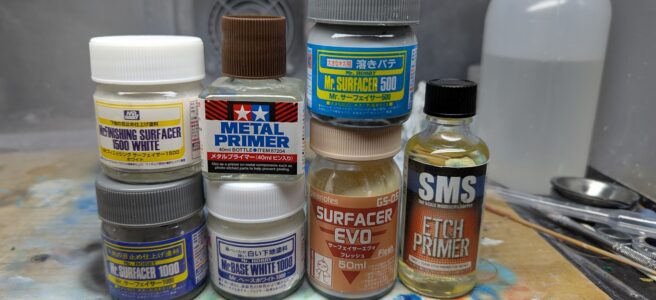
Welcome to What the FAQ, a new series of articles I’m writing to highlight some parts of the hobby I haven’t seen written out plainly and other information that feels more obscure than it needs to be.
Today’s topic is Primer and Surfacer! Both are staples in most people’s paint collections but did you know they serve different purposes?

To start with, not all Surfacers are Primers but all Primers are… Primers. lol.
Surfacers are fillers, used to help fill in imperfections (such as scratches or bubbles) and provide a uniformly coloured surface to start from. They can even be used straight out of the jar as a thin putty! As the paint is layered, the imperfections are covered up
The surfacers from Mr Hobby, which are the most common stocked in hobby stores where I live come in a range of values from 500 – 1500. This range details how big the particles are in the paint (with 500 as the largest and reducing in size as the values increase, same as sandpaper grit) as well as it’s ability to fill imperfections.).

Primer is specifically used to help adhere the paint to the model kit. They can be transparent or opaque paints.
Surfacers can be marketed with primer functions (See Mr Color’s Mr Base Primer or regular hardware store brands that sell “primer and filler” spray cans). This is where my confusion on the topic began and why I thought it might be useful for me to type my findings out here.
I used to paint my kits with just surfacer 1500 as the base coat, under the impression that it doubled as a primer and become frustrated when my paint would easily chip or my masking pulled up the paint.
Changing to using a primer plus a surfacer (As the primer was transparent) fixed my issues. I now use Scale Modeller’s Supply’s Metal Etch Primer (Other metal primers perform the exact same thing) and Mr Hobby’s range of surfacers on top of that (I think Mr Base White 1000 is becoming my favourite due to its solid “hiding power” pigments).
There are methods of painting skin that do not use a surfacer. I’m hoping to get that article out soon about this.
If you’re curious about primer and surfacer brands and a scratch test, here’s a great article by YuzuP!
